

Dutch water technology company selected from 674 submissions after successful demonstration of its solar-thermal desalination system in Abu Dhabi
MAASTRICHT, Netherlands – 12 May 2026 – Desolenator, the Dutch water technology scale-up redefining industrial desalination and circular water infrastructure, today announced its advancement to the semi-finals of the XPRIZE Water Scarcity Competition, the most ambitious and high-profile water desalination competition in the world. Desolenator, in partnership with Silal Group’s Innovation Oasis, a research and development facility specialising in agricultural technology, is among just 20 teams in Track A: System-Level Innovation, selected worldwide from an initial pool of 674 submissions from 86 countries, placing the company among a globally recognised cohort of innovators advancing the next generation of desalination technology.
The XPRIZE Water Scarcity competition is a $119 million, 5-year prize, launched in 2024 and designed to drive widespread access to clean water by creating reliable, sustainable, and affordable seawater desalination systems. Sponsored by The Mohamed bin Zayed Water Initiative (MBZWI) the competition seeks scalable solutions capable of producing 1,000 m³ of clean water per day that can help address the growing threat of global water scarcity.
Desolenator’s semi-final selection marks the completion of the competition’s first physical testing stage in partnership with Silal Group, a UAE-based agricultural and food technology leader, following a rigorous judging process that assessed both the technical strength and real-world feasibility of each team’s solution. The announcement reflects a broader movement in the industry: as XPRIZE has noted, desalination has seen few major breakthroughs since the early 2000s, and the semi-finalist cohort represents the penultimate stage in the global race to make desalination more sustainable, energy-efficient, and cost-effective.
“Reaching the global top 20 is a milestone, not a destination. It validates the science, sharpens the mission, and gives us the conviction to scale faster than the water crisis itself." - Adri Pols, CEO Desolenator
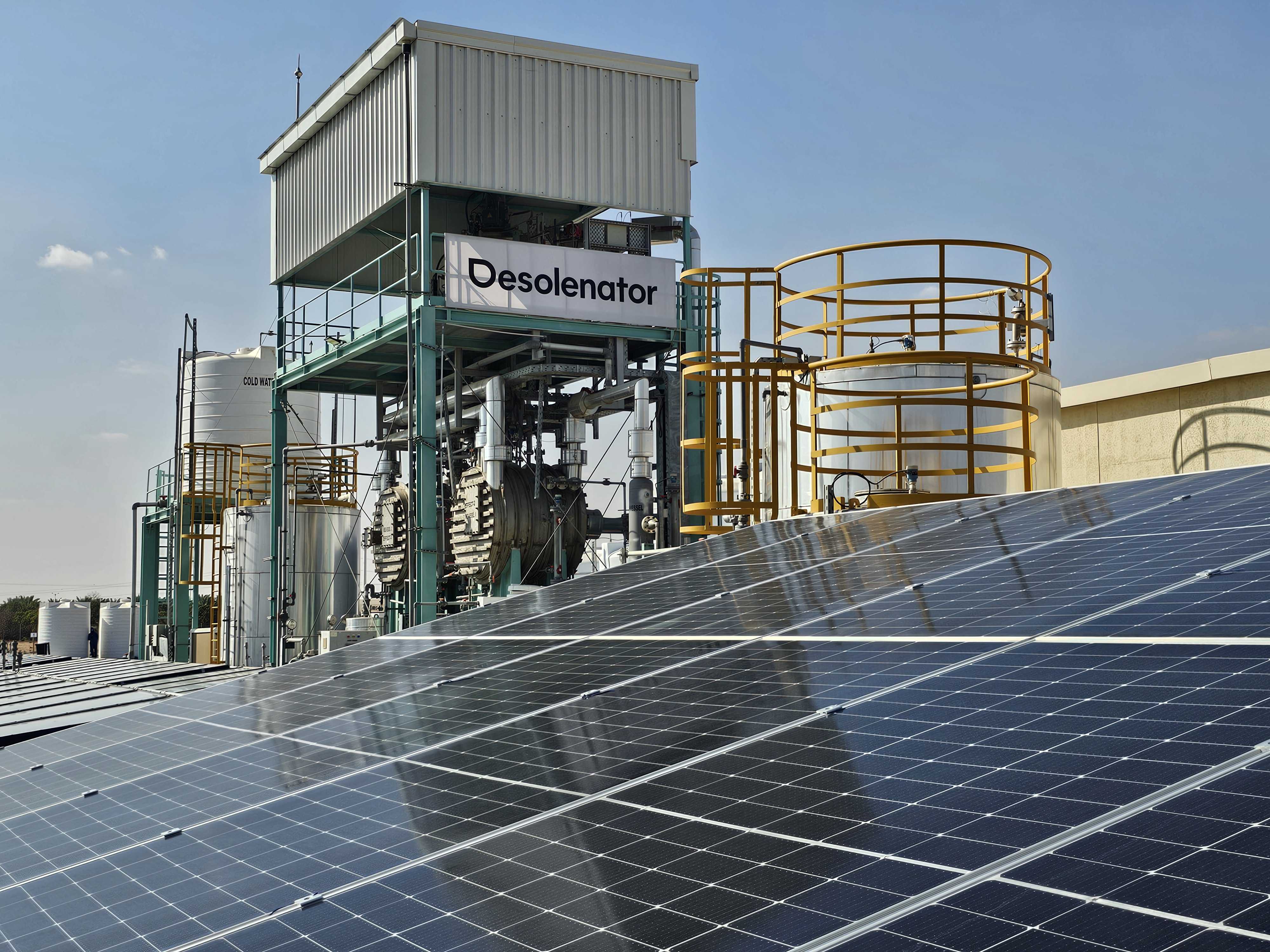
Desolenator's semi-final selection follows successful qualification testing of its pilot-scale demonstrator at Silal Group’s Innovation Oasis in Al Ain, Abu Dhabi: a harsh desert environment representative of some of the world's most water-stressed regions. The testing was conducted at the Innovation Oasis in close collaboration with Silal Group, Desolenator's Strategic Partner for Phase 2 of the competition. Silal Group provided the site, operational support, and deep regional expertise that made the qualification test possible. The partnership reflects Silal Group's commitment to pioneering sustainable water and food security solutions in the UAE and beyond. Desolenator and Silal Group share in the recognition of reaching the top 20 globally.
“At Innovation Oasis, our role is to bring forward technologies that can help solve the region’s water challenge and support more resilient agriculture. We are proud to partner with Desolenator in this competition to help test and showcase the solution in real-world conditions at our pilot facility.” - Dr Shamal Mohammed, CEO Innovation Oasis
During testing, the system produced drinking water in accordance with World Health Organisation (WHO) guidelines from seawater feedstock, validating the real-world performance of the company's modular, heat-driven desalination approach under XPRIZE qualification conditions.
At the core of the system is a patented, hybridised Multi-Effect Distillation (MED) platform that converts low-grade heat - from solar thermal energy, geothermal or industrial waste heat streams - into high-purity water. Unlike conventional membrane-based desalination systems, Desolenator’s approach requires no membranes or chemical consumables, significantly reducing operational complexity and cost with no toxic chemicals, no membrane waste, and nothing left behind.
“I've spent 25 years delivering infrastructure projects across some of the most water-stressed regions on earth. The problem was never that people didn't understand the crisis, it was that the solutions available were too costly, too centralised, and too rigid for where the need actually was. That's what we set out to change.” William Janssen, Founder & COO Desolenator
Desolenator’s advancement reflects a fundamental rethinking of what desalination can be. Traditional large-scale desalination has been energy-intensive, geographically fixed, and environmentally demanding. Desolenator’s decentralised technology is designed to operate at the point of need, integrate with available heat sources, and function as part of a circular water system; reducing dependence on freshwater resources, removing brine discharge through Zero Liquid Discharge (ZLD) capability, and enabling industries and communities to treat water as a recoverable resource rather than a single-use input.
As industrial growth accelerates across data centres, microelectronics, and agriculture in water-stressed regions, the ability to produce clean water efficiently and sustainably is becoming a binding constraint on where and how growth can happen. Critically, these same industries generate significant volumes of low-grade waste heat (at 45°C and above) that Desolenator's systems are designed to capture and convert directly into high-purity water, eliminating the largest cost component of conventional desalination. The result is a model where industrial growth and water production reinforce each other, rather than compete.
“Desolenator has innovated a fundamentally different clean water supply architecture. The shift from centralized, energy-intensive desalination plants to distributed, energy-efficient solar or waste-heat-driven solutions to cost-competitively purify water is the structural change in approach that the potable-water-stressed and increasingly thirsty world needs now more so than ever. Reaching the top 20 globally reconfirms my conviction that this technology is ready to scale." Paddy Padmanathan, Chairman - Desolenator and Former President and CEO of ACWA Power
In the semifinal phase, Desolenator will scale its system to produce 100 m³ per day as an intermediate milestone toward meeting the competition’s final target of 1,000 m³ per day. The company is currently in advanced discussions with commercial deployment partners to host and support the semi-final testing programme, with the semi-final system serving as the foundation for further scale-up toward the final phase.
This deployment-led path to competition progression reflects Desolenator’s broader commercial strategy: to develop technology through real-world industrial partnerships.

